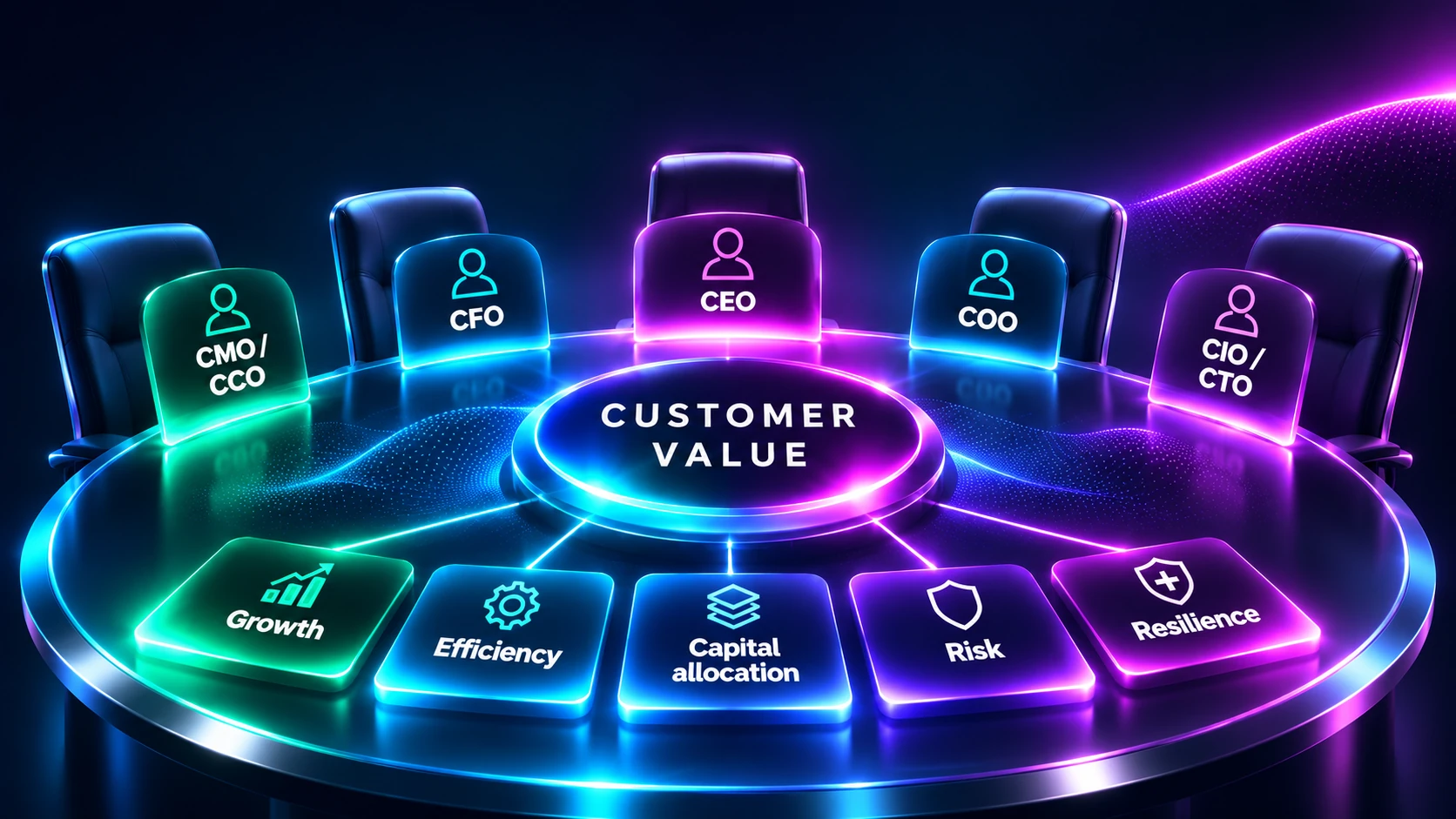
Why customer relationships deserve a clearer place in investment, growth and enterprise value decisions.
Rudolf Germishuys | Founder and CEO | Germishuys Consulting|16 min readRead the perspective ↓
Customer Value · Executive Perspective 05
Customer activity has never been more measurable. Customer relationships remain much harder to value. As capital moves into acquisition, experience, AI, automation and growth, enterprises need a stronger economic view of the relationships those investments are intended to create, develop and protect.
Businesses have become extraordinarily good at measuring customers. We can see acquisition, conversion, channel behaviour, revenue, engagement, satisfaction, churn, complaints, campaign performance, service levels, product usage, cost-to-serve and increasingly granular digital behaviour. The amount of customer evidence available to leadership has grown dramatically.
Yet a deceptively simple question can still be difficult to answer.
What is a customer relationship worth?
Not what did the customer spend last month.Not how satisfied are they.Not how many products do they hold.Not how successfully did a campaign convert them.
What is the economic value of the relationship the enterprise has created—and what should it rationally invest to acquire, develop and protect it?
The implications reach directly into capital allocation. Customer strategy is competing for capital alongside technology, operations, workforce capability, product development and other enterprise investments. CMOs are operating under growing pressure to demonstrate economic impact, while fragmented data continues to make that translation difficult. NIQ's 2026 CMO Outlook reports that 84% of CMOs now prioritise ROI as their primary metric for budget allocation, while 54% identify connecting data from different sources as a major barrier to insight generation.
At the same time, organisations are making increasingly consequential choices about AI, automation, channels and the future shape of customer interaction. The enterprise does not lack customer metrics; it may lack a sufficiently integrated view of what those metrics mean economically.
What the enterprise can measure is not always what the relationship is worth.
01. The Customer Measurement Paradox
More customer data should, in principle, make customer decisions easier. In practice, it has often produced a more fragmented view of the relationship.
Marketing may measure reach, conversion, acquisition and campaign performance.
Sales measures pipeline, revenue and productivity.
Customer teams monitor experience, satisfaction and advocacy.
Service examines volumes, resolution, effort and cost.
Product sees adoption and usage.
Digital teams see journeys and conversion.
Finance sees revenue, margin, cash flow and return.
Each perspective can be valid, yet together they can still fail to answer the same economic question.
A customer may be highly engaged and unprofitable; profitable and close to leaving; acquired through a campaign with excellent conversion but weak future economics; or cheaper to serve after an efficiency intervention that has made the organisation more difficult to deal with.
A service intervention may also increase operating cost while materially protecting valuable relationships.
None of these outcomes can be understood reliably through one customer metric.
This is becoming more consequential as measurement itself fragments. NIQ's 2026 CMO research describes an environment with abundant data but incomplete connectivity; only 37% of surveyed CMOs reported having a centralised data repository easily accessible to stakeholders.
The paradox is therefore not that enterprises know too little about customers. They can know enormous amounts about customer activity without necessarily knowing what the underlying relationships are worth. Traditional customer measures remain important because they tell leadership what is happening. Customer Value adds a different layer: what those outcomes mean economically, how they alter the expected future of the relationship, and how that evidence should influence the next decision.
The enterprise can measure almost everything a customer does without necessarily knowing what the relationship is worth.
02. Revenue Is Not Customer Value
Revenue is one of the clearest indicators of commercial activity. It is not a valuation of the customer relationship that produced it.
Consider two customers generating the same revenue today.
Same visible outcome · different underlying relationship
Current revenue: same
Customer A
Current revenue Same
Lower acquisition cost
Higher margin
Repeat behaviour
Lower cost-to-serve
Stronger retention probability
Development potential
One was acquired efficiently, purchases repeatedly, carries a healthy margin, uses products sustainably, creates relatively little avoidable service cost and has a strong probability of remaining with the organisation.
Expected relationship economicsStronger
Customer B
Current revenue Same
Higher acquisition cost
Discount dependence
Weaker margin
Higher service burden
Higher risk of churn
The other required expensive acquisition, responds primarily to discounting, carries weaker margins, requires significant servicing and appears increasingly likely to leave.
Expected relationship economicsWeaker
Same visible revenue.Different expected relationship economics.
Why the comparison matters
The income recorded today may look similar. What changes the investment decision is the expected quality, durability and economics of the relationship underneath it.
The income recorded from them today may look similar. The economics of their relationships do not.
This distinction is well established in customer valuation. Customer-based valuation work published by the American Marketing Association describes Customer Lifetime Value as the future contribution expected from a customer after considering the economics of acquiring and serving the relationship; Customer Equity extends this logic across current and future customer relationships.
The intellectual foundation is older still. Research by Gupta and Lehmann framed customers as intangible assets whose value can be connected to firm value and strategic decision-making.
This does not make customer economics a substitute for financial valuation. Enterprise value incorporates far more than customers alone: operating costs, investment requirements, tax, capital, financing and other sources of future economic performance remain material.
The value of customer-based thinking is different. It gives leadership another way of seeing where future revenues come from. Financial forecasts may show revenue by period; customer economics asks which relationships are expected to produce it.
Revenue records economic activity. Customer Value asks what remains economically possible in the relationship.
The practical implication is that management decisions are rarely concerned only with what a customer has already done. Leadership is deciding whether to invest again—to acquire more customers like this one, deepen the relationship, protect it, improve its economics or allow the investment to move elsewhere.
Once the future economics of the relationship become visible, customer performance stops being only something the enterprise reports. It becomes something against which capital can be allocated.
Customer relationships change. They are acquired, become active, generate contribution, develop—or do not—require service, become stronger or weaker, and eventually persist, expand, contract, lapse or end. The economics change with them. This is what makes Customer Value useful as a management discipline rather than simply a marketing calculation.
A relationship acquired today carries expectations about future behaviour. Those expectations may involve retention, transaction frequency, product use, margin, service cost, development potential and the investment required to sustain the relationship. As evidence accumulates, those expectations should change too.
A customer who appeared attractive at acquisition may prove expensive to serve; a previously ordinary relationship may become significantly more valuable as needs expand; a customer whose current revenue remains strong may already be signalling declining future value; and a segment considered highly attractive in aggregate may contain cohorts with very different economics. The value is therefore dynamic.
Customer Lifetime Value and Customer Equity provide established mechanisms for thinking about these differences across relationships, cohorts, channels, segments and the wider customer base.
The executive implication is more important than the terminology. A customer relationship is not valuable simply because it exists; its value changes as the economics and expected future of that relationship change.
That creates a different discipline around acquisition because the objective cannot be to acquire every customer available at any cost. It changes retention because protecting a relationship makes economic sense when the expected future value justifies the resources required to do so. It changes development because additional investment should be directed where there is credible potential for the relationship—and the value created for the customer—to deepen.
It also changes the way service is viewed. Cost-to-serve matters, but so does the role that service plays in sustaining trust, reducing friction and protecting future contribution. This is where Customer Value begins to become strategically useful: it gives the enterprise a way to consider the economic life of the relationship, not merely the economics of the latest transaction.
The customer relationship lifecycle
Relationship Start
AcquireBring the relationship in at sustainable economics.
ActivateTurn acquisition into use, engagement and participation.
DevelopDeepen the relationship and grow future potential.
RetainSustain engagement, trust and contribution.
ContinueExpanded relationship value.
DeclineReduced expected value.
ExitRelationship value ends.
Value builds cumulatively.The economics of the relationship change as engagement and contribution deepen.
Value can erode.Service burden, weakening engagement and risk can alter the expected future.
Investment should follow the lifecycle.The opportunity is not only to acquire customers, but to grow and protect the right relationships.
Customer value is a lifecycle outcome. It is created, grown, protected and, if unmanaged, lost.
The value of a customer is not a point-in-time outcome. It is the economic result of a relationship that evolves—and can take different directions.
04. The Quality of Growth
Growth is usually visible in volume: more customers, more sales, more transactions, more revenue. Customer Value adds a second question—what is the quality of that growth?
An enterprise can add customers while weakening its customer economics. Revenue can increase while acquisition costs rise faster. Sales can grow through incentives that weaken margin or attract customers with limited durability. A business can increase conversion while reducing the proportion of customers who stay. It can protect revenue by serving existing relationships better while appearing to grow more slowly than a competitor optimising aggressively for acquisition. Headline growth can therefore conceal very different futures.
Customer-based valuation makes this distinction explicit because CLV can be used to compare the economic quality of customer cohorts, channels and segments rather than treating every acquired customer as equivalent.
The current allocation of marketing investment makes the issue especially visible. Gartner's 2026 CMO Spend Survey found that awareness and conversion account for 62.6% of total media spend, while customer loyalty and retention spending has fallen 29% since 2024 to below 15%. Gartner also observed that more AI-mature marketing organisations allocate proportionately more toward loyalty and retention, warning that less mature organisations risk over-investing in stages and channels that are easiest to optimise and automate.
The issue is not that acquisition is wrong; every enterprise needs new customers. The issue is whether investment decisions are being shaped by the economics of the relationships being created or by the visibility and measurability of the activity used to create them.
Imagine two acquisition channels producing the same number of new customers. Channel A converts cheaply but attracts predominantly promotion-driven customers with limited repeat behaviour. Channel B costs more initially but attracts customers who remain longer, purchase more sustainably and are easier to develop. A cost-per-acquisition comparison favours A. A Customer Value comparison may favour B.
The same applies to retention. Keeping every customer at unlimited cost makes no economic sense, but neither does allowing valuable relationships to disappear because a retention intervention appears expensive when judged only against current-period revenue.
Customer Value introduces a richer decision: what relationship are we acquiring, what relationship are we at risk of losing, what future economics are attached to it, and what investment is justified by that value? Those questions distinguish growth that increases scale from growth that strengthens the enterprise.
Quality of growthSame visible growth. Different relationship quality.
Higher-quality growth
Built on a deeper, stronger customer relationship.
Stronger retention
Deeper engagement
Broader use and value
More resilient and durable economics
Lower-quality growth
Activity-driven and more transactional.
Higher switching risk
Discount dependence
Limited engagement
More vulnerable and less durable value
The value of growth depends on the quality of the customer relationship.The same revenue outcome can create very different economic value over time.
Are we funding growth—or funding what is easiest to count as growth?
The objective is not simply more growth. It is growth whose underlying customer economics make the enterprise stronger.
05. Customer Value Has Two Sides
The customer value equationOne relationship. Value created in two directions.
Value for the customer
The outcomes and experiences the relationship creates for the customer.
Proposition and relevance
Service and advice
Convenience and experience
Trust and utility
Value from the customer
The economic and strategic value the relationship creates for the enterprise.
Revenue and margin
Retention and growth
Advocacy
Future contribution
Value from the customer depends on continuing to create value for the customer.
There is a danger in discussing customer economics only from the enterprise's perspective. Customers do not exist to complete a valuation model. A relationship can continue to create value for the enterprise only while the customer receives enough value to remain in it.
That value may take different forms—price, convenience, trust, quality, advice, availability, recognition, ease, choice, service, relevance or confidence—and the exact combination differs by market and customer. The principle is stable: value from the customer depends on continuing to create value for the customer.
The customer therefore has a vote in the economics of the relationship. They exercise it through behaviour: they stay, leave, buy more, reduce their engagement, recommend the organisation, move to a competitor, tolerate a problem or decide that the effort required to resolve it is no longer worth the relationship.
PwC's 2025 Customer Experience Survey found that 52% of consumers had stopped buying from or using a brand because of a bad product or service experience, while 29% cited poor customer experience specifically. The same research identified a significant perception gap between executives' beliefs about increasing loyalty and consumers' own assessment.
The economics can diverge here because many enterprise decisions are made with an internal definition of value. Efficiency may create value internally; automation may create value internally; channel migration may create value internally. The customer may experience those same interventions differently.
That difference is not simply an experience issue. It can become an economic one. If an intervention saves the enterprise money but increases customer effort, weakens trust, reduces engagement or makes an otherwise valuable relationship easier to leave, some of the efficiency gained on one side of the relationship may ultimately be surrendered on the other. Conversely, an investment that appears more expensive operationally may create greater economic value if it materially strengthens the relationship it supports.
Customer Value therefore requires leadership to evaluate both sides of the exchange: what the enterprise captures from the relationship and what it continues to create within it.
The customer value stress test
Have we out-innovated the customer?
Innovation should strengthen the relationship — not simply make it cheaper to serve.
This is becoming one of the defining tensions of the current AI investment cycle. Organisations are moving rapidly to automate customer interactions, deploy AI agents, redesign service, personalise engagement and reduce manual work. Many of those investments make sense because technology can remove friction, improve availability, shorten resolution time, interpret large amounts of information, personalise interaction, give employees better context and allow scarce expertise to concentrate on complex customer needs.
Customers themselves are becoming more comfortable with it. Gartner's August 2026 customer-service research found that half of surveyed customers believed GenAI had made interactions easier, yet 87% considered access to a human agent essential when companies use GenAI.
Qualtrics' global channel-preference research, covering almost 24,000 consumers across 23 countries, reached a similarly nuanced conclusion: 61% preferred one of the human-mediated channels across the interactions studied, automated chat was the least preferred option at an average of 8%, and trust ranked as the most important channel characteristic.
The message is not that customers reject technology. It is that technology creates customer value when it improves the customer's ability to achieve the outcome they came for. That distinction becomes even more important when the investment case is dominated by efficiency.
This creates a useful test. An interaction can become cheaper without the relationship becoming more valuable. A chatbot can deflect contact and increase customer effort; automation can reduce headcount while removing expertise customers valued; and a digital journey can lower processing cost while making an important life event harder to navigate.
The reverse is equally possible. An AI intervention may reduce effort, improve access, resolve routine needs instantly and allow human capability to concentrate where judgement, empathy or complexity matters. The right evaluation is therefore neither AI versus humans nor automation versus service. It is whether the design improves the economics of the relationship.
Did it improve the customer's outcome, protect trust, remove unnecessary effort, strengthen retention or engagement, create capacity for a better human interaction where one matters, and make the relationship stronger? Over time, did the enterprise capture sufficient economic value from that improvement?
A cheaper interaction is not necessarily a more valuable customer relationship.
The enterprise should certainly capture the productivity, capacity and cost advantages AI can create, but those benefits represent only one side of the investment case when the technology sits directly inside a customer relationship. The other side is what happens to the relationship itself: whether the customer stays longer, finds the organisation easier to deal with, trusts it more, resolves problems more effectively, or encounters opportunities to deepen the relationship rather than merely reduce the cost of servicing it.
The strongest technology case is therefore not the one that removes the most human activity. It is the one that creates the best combination of customer value and enterprise value. That is a different standard for innovation, and it returns us to the underlying discipline of Customer Value: technology should be evaluated not only by what it replaces, accelerates or automates, but by what it does to the economic relationship the enterprise is trying to create, develop and protect.
06. From Customer Metrics to Investment Decisions
Customer Value becomes consequential when it changes a decision. Otherwise it risks becoming another measure on another dashboard. The real opportunity is to use customer economics to sharpen how capital and capability are allocated.
Acquisition
Move from asking how many customers can be acquired to asking which customer relationships the organisation wants to create, through which channels, at what cost and with what expected future contribution.
Retention
Move from treating churn as one aggregate rate to understanding which relationships are weakening, why they matter economically and what level of intervention is rational.
Customer development
Identify where additional propositions, advice, service or engagement could genuinely strengthen both customer outcomes and economic contribution.
Experience
Prioritise the moments that materially affect the relationship rather than attempting to perfect every touchpoint equally.
Marketing
Connect investment to the customer behaviour it is intended to change and ultimately to the commercial and financial consequence of that behaviour.
Sales
Move beyond product volume toward the quality and durability of the relationships being established and developed.
Service
Balance efficiency with the role service plays in resolving friction, maintaining trust and protecting future value.
Technology
Evaluate automation not solely by activities removed or costs reduced, but by what it changes for the customer and the future economics of the relationship.
These decisions cut across functions, which creates a translation problem between customer, marketing and financial evidence. Harvard Business Review has argued that traditional marketing KPIs often fail to connect directly to the business outcomes finance and executive teams use for decision-making.
The objective should not be to eliminate functional measures. A CMO still needs brand measures; a CCO still needs experience measures; sales still needs pipeline; service still needs operational performance; finance still needs earnings, cash flow and return.
The opportunity is to create a stronger economic bridge between them. Customer Value can provide part of that bridge because the customer is one of the few economic realities shared across the system. Marketing influences the relationship, sales creates and develops it, product gives it something to buy, operations fulfils it, service protects it, technology increasingly mediates it, and finance ultimately records the economic consequences.
The customer crosses every one of those boundaries. The investment logic should be capable of doing the same.
07. Putting Customer Value to the Test
The practical value of this thinking becomes clearer when the customer relationship changes the way an enterprise frames the problem itself. Across our work at Germishuys Consulting, this has appeared in different forms.
Case 01 / GC evidence
Choose where value sits
Merchant Outperformance Architecture
In designing a merchant outperformance architecture for an inclusive digital-finance environment, an initial requirement around retention, reactivation and support developed into a wider system connecting customer value, market choice, field-force capability, technology, governance and performance.
The strategic architecture distinguished where acquisition, retention and merchant-profitability opportunities were concentrated before determining how resources and execution should be mobilised.
Customer economics can help determine where to play—not simply how hard to sell.
In advising the CMO and executive marketing leadership of a major financial-services group, the challenge was not a shortage of marketing activity or performance measures. The difficulty was translating that evidence into an enterprise investment language.
The work connected marketing investment through acquisition, retention, usage and customer profitability into financial performance and wider enterprise-value considerations. Campaign and channel measures remained relevant, but attribution alone could not answer the executive question.
Marketing becomes more investable when customer behaviour can be translated into financial consequence.
In another banking engagement, an initial sales-capability brief ultimately became a much wider question about the future of assisted sales and advice. The strategic reframe moved from product-led selling toward helping sales professionals solve customer needs through advice.
Technology was designed to make customer context, distributed expertise, learning and reusable solutions more accessible—not simply to digitise the existing model. The development decision was supported by a five-year cost, return and execution-risk assessment.
Technology creates more strategic value when innovation begins with the customer outcome rather than the technology itself.
In a post-acquisition advisory engagement, sustained performance pressure initially created a leadership question around an acquired operating portfolio. The evidence pointed toward a wider value system.
Investor value, customer commercial value and employee execution value had to be considered together. Customer acquisition, retention, profitability, sales, marketing, product and growth could not be separated from workforce capability, financial performance and the enterprise's longer-term value agenda.
Customer Value is not a marketing construct. It is part of the enterprise-value system.
These examples differ in industry, mandate and starting point. The common discipline is that customer relationships are not treated as an output at the end of strategy. They become part of the evidence used to decide what strategy, investment and execution should do.
08. Put Customer Value at the Investment Table
Customer Value does not require the enterprise to convert every customer interaction into a financial formula. Nor does it mean abandoning brand, experience, trust, creativity or judgement in favour of a single metric.
Some customer investments take time to mature. Some effects are difficult to attribute cleanly. Some decisions create optionality or protect value rather than producing an immediately observable return. Financial precision should never be manufactured where the evidence cannot support it.
The discipline is more fundamental. Customer strategy should carry sufficiently credible economic evidence to participate fully in enterprise investment decisions.
CMO / CCO
CMOs and CCOs should be able to explain how customer investments are expected to change behaviour, relationship economics and ultimately business performance.
CFO
CFOs should be able to see more clearly how acquisition, retention and customer development contribute to the revenues and cash flows contained in financial forecasts.
CIO / CTO
Technology leaders should be able to assess automation against both operational efficiency and customer relationship value.
COO
Operations should understand where cost decisions could unintentionally remove value customers depend upon.
CEO
CEOs should be able to compare investments with a clearer view of which customer relationships the organisation is trying to create, develop and protect.
That brings us back to the original question.
What is a customer relationship worth?
There is no universal answer, and it is not captured by revenue alone, satisfaction, conversion, the number of products held or campaign attribution. Nor should it be reduced mechanically to any single customer-value calculation.
The answer is a disciplined view of the future economic contribution expected from the relationship, considered alongside what the enterprise must continue to invest to create value for that customer and capture value from the relationship.
That perspective changes the conversation. A customer is no longer simply an acquisition target. Retention is no longer simply a percentage. Experience is no longer simply a score. Technology is no longer successful because it automated something. Marketing is no longer evaluated only by activity. Growth is no longer assumed to be equally valuable.
The customer relationship becomes part of the enterprise investment case. That may be increasingly important at a moment when organisations are investing aggressively in technology capable of changing those relationships faster than their ability to understand what they are worth.
Customer Value deserves a place at the investment table because customers are not simply the audience for enterprise strategy.
Their relationships are one of the places where its future economics are created.
Discuss the Customer Value opportunity
If your organisation can see customer activity clearly but finds it harder to connect acquisition, retention, experience, commercial investment and technology decisions to customer and enterprise value, Germishuys Consulting can help.
We work with executive teams to make the customer-value system visible, translate customer and commercial evidence into stronger investment decisions, and connect strategy, execution and measurable economic value.
The objective is a stronger investment decision, with the economics of the customer relationship visible before the enterprise decides where to acquire, retain, automate, serve or grow.